"Finding Elephant"
Installation, concrete
Finding Elephant reflects on the disappearance of unknown territory in the contemporary world. Since the first satellite photographs of Earth in the late 1950s, the planet has gradually become fully visible, mapped, and searchable. There are almost no remaining blank spaces left to discover. Even the ocean floor is being systematically scanned and completed. The work asks whether it is still possible to encounter a place where the world feels unfinished, young, or undiscovered.
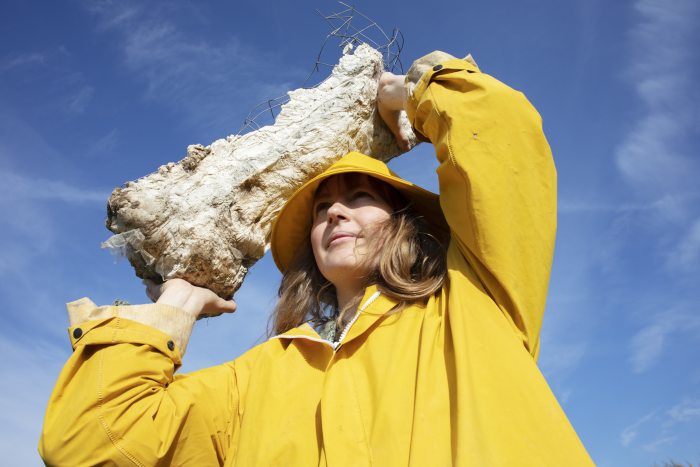
The installation was created through a process resembling fictional archaeology. Different parts of an elephant - a trunk, leg, chest, ear - were first excavated into the ground as negative forms and then cast in concrete. After hardening, the forms were “unearthed” again, as if discovered rather than produced. The process was important to me because it shifted the role of the artist away from direct construction and closer to excavation or revelation.
While working on the piece, I often thought about the Renaissance idea, expressed by Michelangelo, that the sculpture already exists inside the stone and the task of the artist is only to release it. I approached these forms similarly. Once the negative spaces had been made in the earth, it felt as if the result could only become what it eventually became. The work began to behave less like an invented object and more like something that had already existed beneath the meadow before being uncovered.
Because of this, the installation moves between fiction and material reality. The elephant fragments appear simultaneously artificial and archaeological, like remnants of a discovery from a parallel history. The work is less about the elephant itself and more about the human desire to keep searching for something still hidden beneath the surface of an already mapped world.